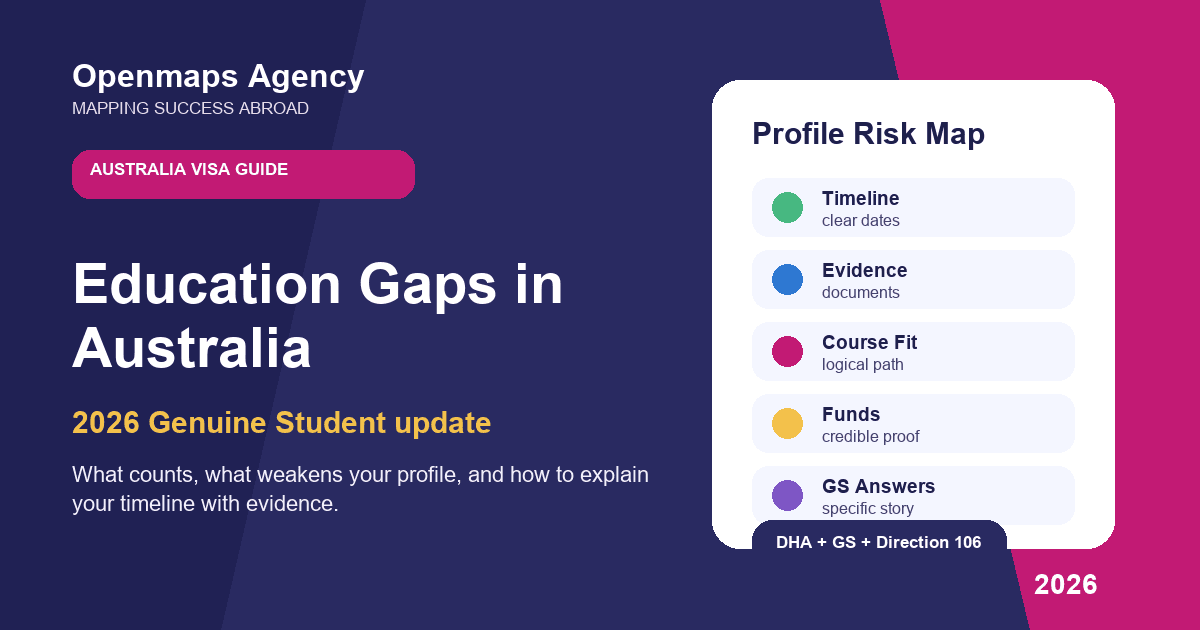
An education gap does not automatically cause an Australian Student visa refusal.
However, a period that is unexplained, poorly documented or inconsistent with the applicant’s course choice may raise questions under the Genuine Student requirement.
The Department of Home Affairs considers the applicant’s circumstances as a whole, including:
- Previous education.
- Current employment.
- Economic circumstances.
- Reasons for choosing the course and provider.
- The value of the course to the applicant’s future.
- Immigration and visa history.
- Supporting documents.
- Whether studying is the primary reason for applying.
Kenyan applicants should prepare a clear timeline showing what they did between their last qualification and the proposed course. Work, business, internships, family responsibilities, health issues, financial preparation and relevant training can all form part of an explanation when they are truthful and supported by evidence.
What Is an Education Gap?
An education gap is a period between formal studies during which an applicant was not enrolled in school, college or university.
Common examples include:
- A break after completing KCSE.
- Several years between a diploma and a bachelor’s degree.
- A long period between a bachelor’s degree and postgraduate study.
- Leaving a previous course without completing it.
- Time spent unemployed.
- A career break for health or family reasons.
- Delayed study caused by finances or unsuccessful applications.
- A period of employment before returning to education.
Time away from formal education is common. The key issue is whether the applicant can explain the period and show why returning to study now is reasonable.
What the Genuine Student Requirement Says
The Genuine Student requirement applies to Student visa applications lodged on or after 23 March 2024.
Home Affairs requires an applicant to demonstrate that studying in Australia is the primary reason for applying for the visa.
The online application asks applicants to explain:
- Their current circumstances, including family, community, employment and economic ties.
- Why they selected the particular course and education provider.
- Their understanding of studying and living in Australia.
- How completing the course will benefit them.
- Any other relevant information.
Each main response has a limit of 150 words and must be written in English. Home Affairs also states that supporting evidence carries more weight than unsupported statements.
The current requirements are explained on the Department of Home Affairs Genuine Student page.
Does Home Affairs Have a Maximum Acceptable Gap?
Home Affairs does not publish a simple rule stating that every gap above a particular number of months or years will lead to refusal.
There is therefore no universal rule that a two-year, five-year or ten-year gap is automatically acceptable or unacceptable.
The effect of a gap depends on the complete application. Relevant considerations may include:
- What the applicant did during the period.
- Whether the activities can be verified.
- How recently the applicant studied.
- Whether the proposed course is at an appropriate level.
- Whether it relates to previous education or employment.
- Why the applicant needs the qualification now.
- Whether the financial plan is credible.
- Whether dates and statements are consistent.
A long gap with clear employment and career progression may be easier to explain than a shorter period containing unexplained or contradictory information.
What Ministerial Direction 106 Means for Gap Cases
Ministerial Direction 106 guides decision-makers assessing the Genuine Student criterion.
It directs them to consider the applicant’s overall circumstances rather than treating every factor as a fixed checklist.
Closer scrutiny may be considered where:
- The proposed field is unrelated to previous studies or employment.
- The application contains apparent inconsistencies.
- The applicant has a visa history that requires examination.
- The applicant previously held one or more Student visas.
- Other information raises concerns about the primary reason for seeking the visa.
An education gap is therefore considered within the broader profile. It should be addressed alongside course progression, employment, finances and immigration history.
Strong Reasons for an Education Gap
A strong explanation is truthful, specific and supported by evidence.
Employment
A student may have worked before deciding to continue studying. Relevant evidence can include:
- Employment letters.
- Contracts.
- Payslips.
- Bank statements showing salary payments.
- Tax or statutory records.
- Work identification.
- References from supervisors.
The explanation should state the dates, position, responsibilities and connection between the experience and proposed course.
Running or supporting a business
Business experience may explain a gap if the activity is genuine and documented.
Possible evidence includes:
- Business-registration records.
- Licences or permits.
- Tax documents.
- Invoices and receipts.
- Business bank statements.
- Supplier or customer records.
- A letter confirming work in a family business.
A general statement that the applicant “helped with business” may be weak without dates, duties and supporting records.
Internship, attachment or volunteering
Internships and volunteer work can help explain a period when they are properly documented.
A letter should ideally identify:
- The organisation.
- Start and end dates.
- Duties performed.
- Hours or working arrangement.
- Contact details for verification.
Financial preparation
An applicant may have delayed study while working, saving or arranging family sponsorship.
The explanation should show what happened during this period. Simply stating that the applicant was “looking for money” may be insufficient without evidence of employment, savings, sponsor preparation or earlier study attempts.
Health or family responsibilities
Illness, recovery, maternity, childcare, bereavement or caring for a relative may provide a legitimate explanation.
Only information relevant to the application should be disclosed. Evidence may include medical documents, birth records or other records connected with the circumstances.
Further training
Relevant short courses, professional certifications and English preparation may support the timeline.
Their value depends on:
- Duration.
- Relevance.
- Provider credibility.
- Evidence of completion.
- Connection to the applicant’s career or proposed course.
A collection of unrelated certificates does not necessarily provide a persuasive explanation for several years away from education.
Previous applications or deferred admission
Some students delay study because an intake was deferred, funding was unavailable or an earlier application was unsuccessful.
Evidence may include:
- Previous offer letters.
- Deferral notices.
- Application correspondence.
- English-test results.
- Visa decisions.
- Scholarship applications.
Previous visa refusals must be disclosed accurately where requested.
Are Computer and Driving Courses Enough?
A computer course or driving course is not automatically ignored. It may form part of the timeline if it genuinely occurred and can be documented.
Its usefulness depends on context.
A three-month computer course is unlikely to explain a three-year gap by itself. A professional driving qualification may be relevant for someone who subsequently worked as a driver, transport operator or logistics employee.
Applicants should not stretch a short activity to cover a much longer period. Every major part of the timeline should be accounted for honestly.
How to Build a Complete Timeline
Begin with the month and year when the most recent qualification ended. Continue month by month or period by period until the intended Australian intake.
The timeline may contain entries such as:
- January 2021 to December 2021: Diploma studies.
- January 2022 to March 2022: Job search.
- April 2022 to August 2024: Employment.
- September 2024 to November 2024: Professional training.
- December 2024 to present: Employment and preparation for postgraduate study.
After drafting the timeline:
Compare it with academic certificates and transcripts.
Compare it with the CV.
Check employment and business documents.
Check passport travel dates.
Review previous visa applications.
Check dates used in the university application.
Ensure the Genuine Student responses match everything else.
Overlapping dates are acceptable when activities genuinely occurred together. They should still be explained clearly.
Evidence That May Support a Gap
Depending on the applicant’s circumstances, useful evidence may include:
- Academic transcripts and certificates.
- Employment letters with dates and duties.
- Contracts and payslips.
- Bank statements showing regular salary payments.
- Business-registration and tax records.
- Internship or attachment letters.
- Volunteer records.
- Professional certificates.
- English-test bookings and results.
- Medical evidence.
- Evidence of caring responsibilities.
- Previous applications and offer letters.
- Deferral correspondence.
- A CV showing month-and-year dates.
Students should submit genuine documents that can be verified. False or altered documents can cause refusal and potentially more serious immigration consequences.
Connecting the Gap to the Proposed Course
Explaining what happened is only one part of the task. The applicant should also explain why the proposed course is a logical next step.
A strong explanation may show that the qualification will:
- Build on existing academic knowledge.
- Add specialised skills needed for career progression.
- Address a skills gap discovered through employment.
- Support movement into a related professional role.
- Provide knowledge unavailable in the applicant’s previous programme.
- Improve realistic employment opportunities in Kenya or another relevant market.
A course change can be genuine. However, a move into an unrelated field usually requires a clear career explanation and evidence that the applicant understands the new area.
Writing the Gap Explanation
A useful structure is:
State the exact period.
Explain what occurred.
Identify the supporting evidence.
Explain what the applicant learned or achieved.
Connect the experience with the proposed course.
Explain why this is the appropriate time to resume study.
For example:
From January 2023 to August 2024, I worked in my family’s retail business while preparing financially for postgraduate study. My duties included stock control, customer service and maintaining basic sales records. The attached business letter and transaction records support this period. The experience increased my interest in business operations and helped me identify the management skills I now intend to develop through the proposed course.
The final response should reflect the applicant’s real circumstances. Templates should be adapted carefully rather than copied.
Common Mistakes
Common mistakes include:
- Hiding a gap from the CV.
- Inventing employment or training.
- Using inconsistent dates.
- Relying on one short certificate to explain several years.
- Providing employment letters without credible contact details.
- Submitting unsupported claims about a family business.
- Changing fields without explaining the career logic.
- Using copied Genuine Student answers.
- Giving long background stories without answering the actual question.
- Claiming that permanent residence is guaranteed.
- Failing to disclose previous refusals.
- Submitting altered or unverifiable documents.
Frequently Asked Questions
Does an education gap automatically cause refusal?
No. Home Affairs assesses the complete application. The applicant should explain the gap and support the explanation with relevant evidence.
How many years of study gap does Australia accept?
There is no single published maximum that applies to every Student visa applicant. The circumstances, evidence and course logic matter.
Can work experience explain a gap?
Yes. Employment can provide a credible explanation when the dates, employer, duties and supporting evidence are consistent.
What if I was unemployed?
Explain the period truthfully. Include relevant activities such as job applications, family responsibilities, training, volunteering or financial preparation where they genuinely occurred.
Should a gap appear on my CV?
A CV should present a complete and accurate timeline. Unexplained periods can be addressed directly instead of being hidden.
Can a short computer course explain several years?
It may support part of the timeline, but a short course alone will rarely account for a much longer period.
Can I change to a different field after a long gap?
A change may be possible, but the applicant should explain why the new field is appropriate and how it supports a realistic career plan.
Do I need a separate gap letter?
Home Affairs prefers applicants to respond to the questions in the online application form. Supporting documents should be attached through ImmiAccount. Whether an additional explanation is useful depends on the case and application instructions.
Are Genuine Student answers limited?
The main online Genuine Student responses have a limit of 150 words each and must be written in English.
Can strong evidence guarantee the visa?
No. Evidence helps Home Affairs assess the application, but admission and visa outcomes cannot be guaranteed.
Francis Mwaura’s Overview
Francis Mwaura advises students to address education gaps before selecting a course and paying major fees.
The first task is to build an accurate timeline. The second is to evaluate whether the new course makes sense in view of the applicant’s education, employment and career plans. The third is to collect evidence that supports the explanation.
A carefully documented gap can be understood. Contradictory dates, vague explanations and documents created only for the application can weaken the credibility of the entire file.
How Openmaps Helps
Openmaps Education Agency supports students with:
- Education-gap assessments.
- CV timeline reviews.
- Course and career alignment.
- Genuine Student response preparation.
- Supporting-document checklists.
- Financial and sponsor-document planning.
- Application consistency reviews.
Each case is assessed on its individual facts. Openmaps cannot guarantee admission or a visa decision.
Official Sources Checked
Official information checked on 22 September 2026:
- Department of Home Affairs — Genuine Student requirement
- Department of Home Affairs — Subclass 500 Student visa
- Department of Home Affairs — Ministerial Direction 106
Important Disclaimer
This article provides general educational information and does not constitute legal or immigration advice. Visa criteria and procedures may change. Applicants should check the current Department of Home Affairs requirements and obtain individual guidance where necessary.