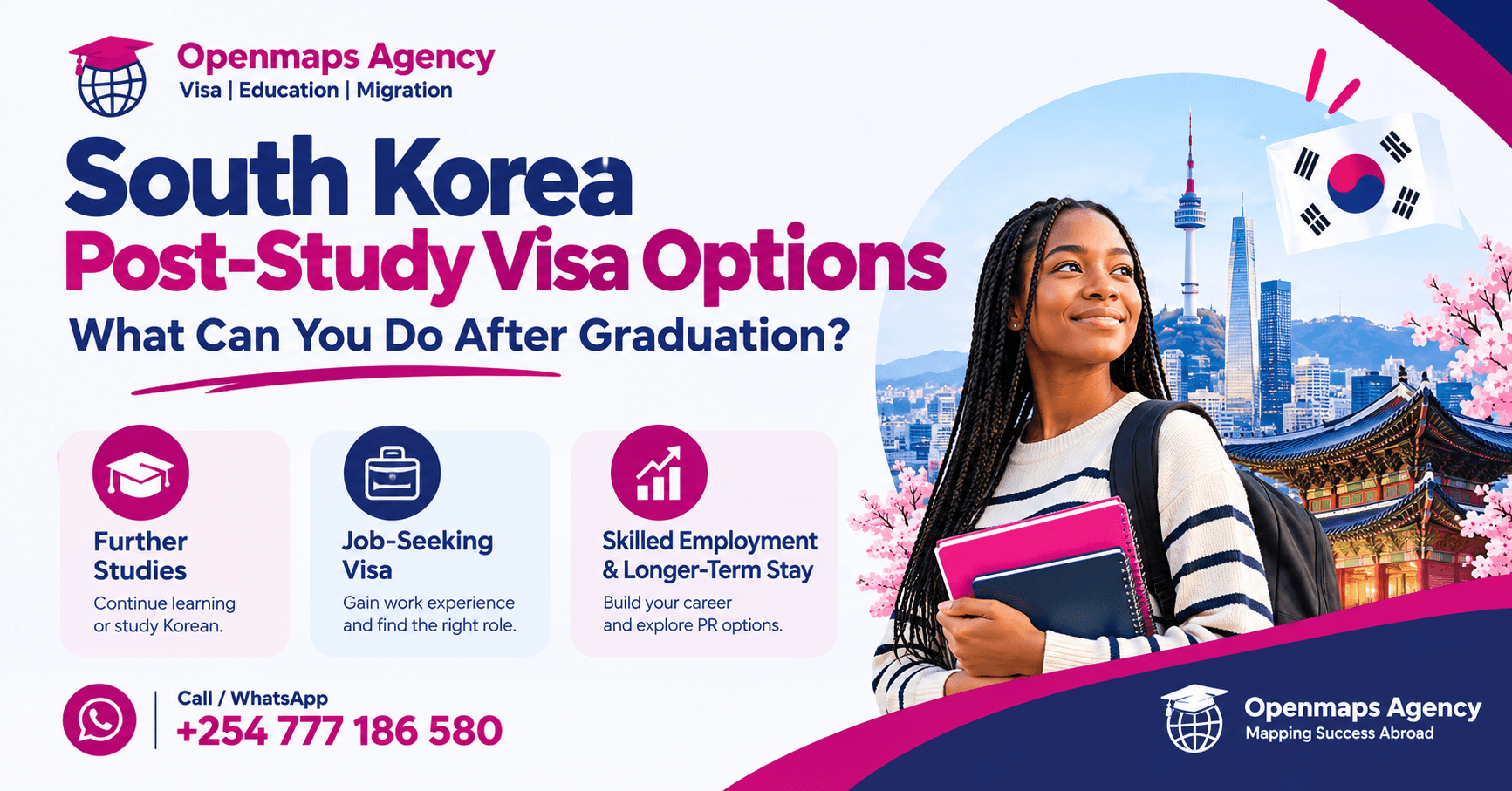
South Korea Post-Study Visa Options: What Can You Do After Graduation?
Studying in South Korea can be about more than earning a qualification. For students interested in building an international career, it is worth understanding the options available after graduation before choosing a course.
South Korea has pathways for eligible international graduates to seek professional employment, move into qualifying jobs, pursue research or explore certain start-up opportunities. However, the right route depends on your qualifications, job offer, skills and immigration eligibility.
1. D-10-1: Job-Seeking Visa
The D-10-1 allows eligible graduates to stay in South Korea to look for qualifying professional employment and undertake permitted internships.
The Korean government announced reforms extending the job-seeking period available to graduates of Korean universities. Always confirm the current duration, extension rules and application requirements before making plans.
Good to know: This is a job-search route, not an unrestricted work visa. You must change to the appropriate status before taking up employment that requires another visa.
2. E-7: Professional Employment
The E-7 category covers specified professional and skilled occupations. Eligibility depends on the job, the applicant’s qualifications, the employer and the relevant immigration rules.
Graduates may wish to research roles in areas such as software development, engineering, life sciences, design, and selected business or marketing occupations.
A Korean qualification can be helpful, but it does not guarantee a qualifying job or visa. Research actual job advertisements and check the visa requirements for your intended occupation.
3. Research and Academic Careers
Students interested in research may wish to investigate the E-3 research category. Eligible academic appointments may also fall under the E-1 professor category.
These routes have specific requirements, and the position and institution must qualify. They are particularly worth exploring for students considering postgraduate study in science, technology or research-focused disciplines.
4. Start-Up Opportunities
If you plan to build a business, South Korea has routes for eligible applicants preparing a start-up and separate requirements for business investment.
The D-10 start-up preparation route may be relevant to certain applicants. A subsequent business or investment status, such as D-8, has its own criteria. Do not assume that a business idea or university degree alone qualifies you.
5. Longer-Term Residence
Some graduates may eventually qualify for a residence status such as F-2-7, which uses a points-based system. Eligibility can depend on factors including education, income, age and employment.
This is not an automatic next step after graduation. Check the current points system and requirements for your circumstances.
Which Career Areas Should You Explore?
South Korea identifies several advanced industries as strategic areas for attracting international talent. Depending on your interests and qualifications, you could research:
- Semiconductors and electronics: electrical engineering, materials science and semiconductor technology.
- AI, software and data: computer science, artificial intelligence, data science and cybersecurity.
- Biotechnology and life sciences: biotechnology, biomedical science and bioinformatics.
- Batteries and advanced mobility: chemical engineering, battery technology, robotics and electric-vehicle systems.
- Industrial engineering: automotive, shipbuilding, manufacturing and automation.
- International business: trade, logistics, multilingual marketing and international customer support.
These are career areas to investigate, not a guaranteed list of shortage occupations. Actual demand varies by role, employer and year.
Does Korean Language Ability Matter?
It can make a significant difference. The level required depends on the employer and job, but many roles involve Korean-language communication. Start developing your Korean while studying and check the language requirements in job advertisements for your target field.
Not sure where to start? Our partner, Woosong University, offers a one-year Korean language programme to help you develop your language skills.
Plan Your Career Before You Choose Your Course
Before applying, consider the jobs you might want after graduation, whether those roles can qualify for an employment visa, what skills employers expect and how much Korean you may need.
Openmaps can help you explore study options in South Korea and consider how your course choices fit your longer-term goals.
Interested in studying in South Korea? Contact Openmaps to explore your options.
Immigration requirements can change. Visa categories, eligibility and permitted activities must be confirmed through official Korean immigration guidance. Studying in South Korea does not guarantee employment or a post-study visa.
Official resources to check:
- Study in Korea: https://www.studyinkorea.go.kr/
- Korea Immigration Service: https://www.immigration.go.kr/
- Korea Visa Portal: https://www.visa.go.kr/